
Living in Salento Beyond 90 Days: Elective Residency and Digital Nomad Visas Explained
One of the most common misunderstandings we encounter with British, American and other non-EU buyers is the assumption that owning a home in Salento comes with the right to live in it year-round. It doesn’t. Property ownership and residency are completely separate matters under Italian and EU law, and non-EU citizens are still bound by the Schengen 90/180-day rule unless they hold a valid visa or residence permit — a point we also touch on in our overview of how to buy property in Puglia as a foreigner. Here are the two routes we see most Salento buyers actually use.
The Schengen 90/180 Rule — Why It Matters Even If You Own Property
Non-EU citizens (this includes British passport holders post-Brexit) can spend up to 90 days within any rolling 180-day period across the whole Schengen area, Italy included, without a visa. Owning your villa in Porto Cesareo or your apartment in Lecce changes nothing about this — you are still a visitor for immigration purposes unless you obtain a long-stay visa and residence permit (permesso di soggiorno).
Route One: The Elective Residency Visa
Designed for financially independent people who want to live in Italy without working — this is the route most retirees and early-retirees choose. Requirements as they currently stand:
- Stable, passive income — pension, investment income, or rental income, not employment or remote work earnings. The commonly cited minimum is around €32,000/year for a single applicant and €38,000/year for a couple, with roughly €6,200 extra per dependent child, though Italian law technically requires only “ample, autonomous, stable and regular means” and exact figures can vary by consulate.
- Proof of accommodation in Italy — a property deed (your Salento purchase counts) or a lease of at least one year.
- Private health insurance valid in Italy for the visa duration.
- No permitted employment — this visa explicitly does not allow working in Italy, including remote work for a foreign employer.
The visa is granted for one year initially, renewed annually provided you continue to qualify, and after 10 years of legal residence you can apply for Italian and EU citizenship. This is the route we see most often among buyers researching how to retire in Puglia.
Route Two: The Digital Nomad Visa
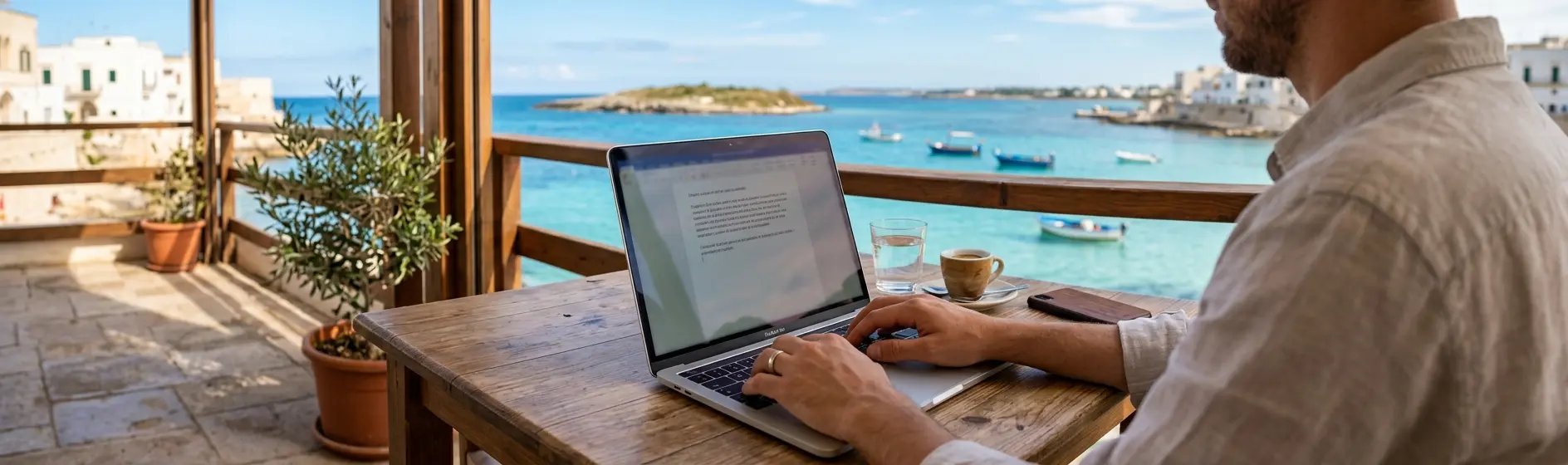
Introduced for remote workers and freelancers who want to live in Italy while continuing to work for employers or clients based outside the country. Key requirements:
- Minimum income around €28,000/year.
- Qualification — a university degree, a recognised professional licence, or several years of relevant work experience (a shorter threshold applies for ICT roles).
- Remote work history — typically at least six months already working remotely before applying.
- Employer or clients based outside Italy — this visa is not a route to working for an Italian company.
- Health insurance with a minimum coverage level (commonly cited around €30,000) and proof of Italian accommodation.
Processing typically takes 1-4 months depending on the consulate. Unlike elective residency, this route is realistic for buyers in their 30s-50s still actively working, not just retirees.
Which Route Fits Which Buyer
Retirees and financially independent buyers with pension or investment income: elective residency. Remote-working professionals and freelancers still earning a salary or client income: digital nomad visa. Buyers who simply want a holiday home and plan to stay under 90 days per visit: neither is necessary — the Schengen rule already covers you. For a wider look at what day-to-day life actually involves once you’re here, see our honest guide to living in Salento as an expat, and our breakdown of the true cost of living in Lecce for budgeting either route.
Frequently Asked Questions
Does buying a house in Salento give me the right to live there full-time?
No. Property ownership has no bearing on immigration status. Non-EU citizens still need a long-stay visa and residence permit to remain beyond 90 days in any 180-day period.
Can I use remote work income to qualify for the elective residency visa?
No — elective residency requires passive income (pensions, investments, rental income). Active remote work income is what the digital nomad visa is specifically designed to cover instead.
What happens if I overstay the 90 days without a visa?
You risk fines, entry bans on future Schengen travel, and complications for future visa applications. It is worth tracking your days carefully if you split time between Salento and your home country.
Sources: Ministero degli Affari Esteri e della Cooperazione Internazionale — visti per l’Italia; Polizia di Stato — permesso di soggiorno.
Free: The Salento Buyer's Checklist & Cost Breakdown
Know exactly what buying property in Salento costs — before you make an offer. Get the free 2026 checklist and total-cost breakdown by email.