
How to Buy Property in Puglia as a Foreigner: Complete Guide 2026
Buying property in Puglia as a foreigner is entirely possible — and increasingly popular. British, German, Dutch, and American buyers are discovering that Salento offers exceptional value, a warm climate, and a quality of life that is hard to match anywhere in Europe. This guide covers everything you need to know before making your purchase. Still deciding where in Italy to buy? Our comparison of Puglia, Tuscany and the Amalfi Coast weighs the three on price, lifestyle and rental return.
Can Foreigners Buy Property in Italy?
Yes. Citizens of most countries can purchase property in Italy freely. EU citizens have the same rights as Italian nationals. Non-EU citizens (including British, American, and Australian buyers) can also buy property, provided their home country has a reciprocity agreement with Italy — which applies to most Western nations. Owning a home here and living here full-time are two different questions: if you plan to stay beyond 90 days, our guide to elective residency and digital nomad visas sets out which route fits you.
Step-by-Step: The Italian Property Buying Process
1. Get an Italian Tax Code (Codice Fiscale)
Before anything else, you need a Codice Fiscale — the Italian equivalent of a tax identification number. You can obtain one at the Italian consulate in your home country or at any Italian tax office (Agenzia delle Entrate) upon arrival. It is free and takes minutes to issue. For a step-by-step walkthrough of the codice fiscale and how to set up a power of attorney from abroad, see our guide to the paperwork foreign buyers need first.
2. Open an Italian Bank Account
While not legally required, an Italian bank account makes the purchase process significantly easier. It allows you to pay the deposit, transfer funds, and later pay utility bills and local taxes. Most major Italian banks offer accounts for non-residents. When the time comes to move the purchase funds, the exchange rate can shift your budget by thousands: our guide to transferring money to Italy shows you how to lock in a good rate.
3. Make an Offer (Proposta di Acquisto)
Once you have found your property, you submit a written purchase proposal accompanied by a small deposit (typically 1–2% of the agreed price). If the seller accepts, the offer becomes binding.
4. Sign the Preliminary Contract (Compromesso)
The Compromesso is a legally binding preliminary contract signed by both parties. At this stage, the buyer pays a deposit of 10–20% of the purchase price. If the buyer withdraws, the deposit is forfeited. If the seller withdraws, they must return double the deposit. Wondering what happens between this signature and the final one? Our timeline from preliminare to rogito walks you through the process month by month.
5. Final Deed (Rogito) Before a Notary
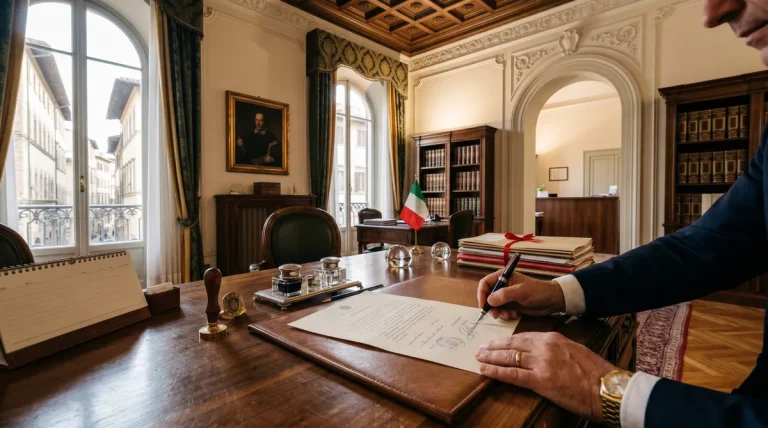
The final step is signing the Rogito (deed of sale) in the presence of a Notaio (notary). The notary is a public official who verifies the legality of the transaction, checks the property is free of debts or legal issues, and registers the transfer with the land registry. The notary’s fee is not fixed by law, so ask for a written estimate before you choose. Once the keys are yours and you fly home, our guide for absentee owners covers keyholding, maintenance and letting from abroad.
Costs and Taxes When Buying in Italy
Beyond the purchase price, budget for the following additional costs:
- Registration tax: 9% of the cadastral value for non-primary residences (2% if you establish Italian residency within 18 months)
- Notary fees: not fixed by law, so ask for a written estimate
- Agency fee: agreed case by case
- Legal fees: €1,500–€3,000 if you use an independent lawyer
- Survey/technical report: €500–€1,500
To put numbers on it: a second home bought from a private seller for €250,000, with a cadastral value of €90,000, carries €8,200 in taxes, about 3.3% of the price. Notary, legal, survey and agency fees come on top. These figures assume a resale purchase: buying a new build from a developer changes the tax picture. Our new build vs resale guide compares the two on tax, warranty and timeline.
Do I Need a Lawyer?
It is not legally required, but strongly recommended for foreign buyers. An independent lawyer (geometra or avvocato) will review contracts, conduct due diligence on the property title, check for planning irregularities, and ensure your interests are protected throughout the process. The notary acts for both parties and the state — they do not represent you. Before you sign anything, run through our due diligence checklist for buying in Salento: it lists exactly what to verify, and who should verify it.
Can I Get a Mortgage in Italy as a Foreigner?
Yes, though it is more complex than for Italian residents. Non-EU buyers can typically borrow up to 60% of the property value. EU buyers may access up to 80%. You will need to provide proof of income, tax returns, and bank statements. Several Italian banks specialise in mortgages for non-residents, including BNL and Credem.
Why Buy in Salento Specifically?
- Property prices 40–60% lower than Tuscany for comparable quality
- Two coastlines: Adriatic and Ionian, both with crystal-clear water
- 300 days of sunshine per year
- Direct flights from London, Amsterdam, Frankfurt, and Brussels
- Strong holiday rental demand — average yield 5–8% in coastal areas
- Authentic Italian lifestyle with minimal mass tourism
Frequently Asked Questions
How long does the buying process take in Italy?
From accepted offer to final deed (Rogito), the process typically takes 2–4 months. It can be faster if financing is not required.
Can I buy property in Italy without visiting in person?
Yes. You can grant power of attorney (procura) to a trusted representative — such as a lawyer or estate agent — who can sign documents on your behalf. However, we always recommend at least one visit before committing to a purchase. If you are planning that trip, our month-by-month guide to visiting Salento shows you which season lets you judge a property honestly.
Is it safe to buy property in southern Italy?
Yes, provided you work with qualified professionals and conduct proper due diligence. The key is using an independent notary, a reputable local estate agent, and — ideally — an independent lawyer to review all documentation.
Can foreigners buy property in Italy?
Yes. Citizens of most countries can purchase property in Italy freely. EU citizens have the same rights as Italian nationals. Non-EU citizens including British, American and Australian buyers can also buy property in Salento, provided their home country has a reciprocity agreement with Italy.
What are the costs of buying property in Puglia as a foreigner?
Beyond the purchase price, budget for registration tax (9% of cadastral value, or 2% if you establish Italian residency within 18 months), notary fees (not fixed by law, so ask for a written estimate), agency fee (agreed case by case), and legal fees. Since the 9% applies to the cadastral value, ask for that figure before you make an offer: your tax bill turns on it.
Do I need a lawyer to buy property in Salento?
It is not legally required but strongly recommended for foreign buyers. An independent lawyer will review contracts, conduct due diligence on the property title in Salento or Puglia, and ensure your interests are protected. The notary acts for both parties and the state — they do not represent you.
Start Your Property Search in Salento
We have been helping international buyers find their perfect home in Salento since 1994. Contact us for a free, no-obligation consultation in English.
Free: The Salento Buyer's Checklist & Cost Breakdown
Know exactly what buying property in Salento costs — before you make an offer. Get the free 2026 checklist and total-cost breakdown by email.