
Property Taxes in Italy for Foreigners: Complete Guide 2026
One of the most common questions we hear from British, German, Dutch and American buyers is: “How much will I actually pay in taxes when I buy a property in Italy?”
Italian property taxes work differently from what most northern European or American buyers are used to, and the differences are worth knowing before you sign anything. The rates below are those in force in 2026. Treat them as a guide, not as advice on your own position: what you actually pay turns on the cadastral value of the specific property and on where you are tax resident, so have a commercialista — an Italian accountant and tax adviser — check your own case.
The Two Main Scenarios: First Home vs Second Home
The most important distinction in Italian property taxation is whether the property will be your primary residence (prima casa) or a second home (seconda casa). This single factor determines which tax rates apply and whether you qualify for significant discounts.
As a foreigner, you can qualify for the prima casa tax benefit if you commit to transferring your official residence (residenza anagrafica) to the property’s municipality within 18 months of purchase. Many international buyers who plan to relocate permanently or spend the majority of the year in Salento take advantage of this.
Taxes Due at the Time of Purchase
When you buy a property in Italy, you pay a one-off set of purchase taxes at the notary on the day of completion. These are the main ones:
1. Imposta di Registro (Registration Tax)
This is the main purchase tax in Italy when buying from a private seller (the most common scenario in Salento).
- Prima casa (primary residence): 2% of the taxable base
- Seconda casa (second home): 9% of the taxable base
- Minimum payable: €1,000 in either case
Important, and often missed: the tax can be calculated on the cadastral value (valore catastale) instead of the price you pay — but it is not automatic. It applies to homes bought by a private individual, and only if the buyer asks the notary for it in the deed. That request is the prezzo-valore mechanism, and it is worth asking for: cadastral values sit well below market prices, so the difference in tax is large. Without it, the tax is worked out on the price.
2. Imposta Ipotecaria (Mortgage/Land Registry Tax)
- Prima casa: fixed fee of €50
- Seconda casa: fixed fee of €50
3. Imposta Catastale (Cadastral Tax)
- Prima casa: fixed fee of €50
- Seconda casa: fixed fee of €50
Buying from a Developer (VAT applies instead)
If you buy a new-build or recently renovated property directly from a construction company, VAT (IVA) replaces the registration tax:
- Prima casa: 4% VAT on the sale price
- Seconda casa: 10% VAT on the sale price (22% for luxury properties)
Real Cost Example
To make this concrete, here is a practical example for a €250,000 property in Lecce with a cadastral value of €90,000:
| Tax | Prima Casa | Seconda Casa |
|---|---|---|
| Imposta di Registro | €1,800 (2%) | €8,100 (9%) |
| Imposta Ipotecaria | €50 | €50 |
| Imposta Catastale | €50 | €50 |
| Total purchase taxes | €1,900 | €8,200 |
The prima casa benefit makes a substantial difference: on this property it saves about €6,300 in purchase taxes. Note that the mortgage and cadastral taxes are €50 each in both columns — they have been fixed fees since 2014 on any purchase from a private seller. Both columns assume the same taxable base for simplicity; in practice the multiplier applied to the rendita catastale differs between prima casa and seconda casa, so ask your notary to run the figures on the actual property.
Annual Property Tax: IMU
Once you own a property in Italy, you pay an annual municipal property tax called IMU (Imposta Municipale Propria).
- Main home (abitazione principale): exempt from IMU — but the exemption follows where you are resident and actually live, not the prima casa discount you got at purchase. Buy as prima casa but keep your residence elsewhere, and you pay it. Luxury cadastral categories pay it in any case — A/1 stately homes, A/8 villas in the cadastral sense, A/9 castles and historic buildings; an ordinary house called a villa in the listing is not usually one of them.
- Second home: a municipal rate between 0.76% and 1.06% a year, applied to the taxable base set out below
For most properties in Salento, the annual IMU on a second home works out to between €500 and €2,500 per year — a manageable figure for most buyers.
How IMU is calculated: Base = rendita catastale × revaluation coefficient (1.05) × category multiplier (160 for residential). The municipal rate is then applied to this figure. The figure you start from is the rendita catastale (cadastral income), which you read off the property’s visura catastale, not the cadastral value used for registration tax — they are different numbers. Example — villa in Porto Cesareo with a rendita catastale of €900: €900 × 1.05 × 160 = €151,200, and at a municipal rate of 1.06% that comes to about €1,602 a year. IMU is paid in two instalments: 16 June (50% advance) and 16 December (balance), via F24 form at any Italian bank, post office or online via the Agenzia delle Entrate portal.
Other Annual Costs to Budget For
| Cost | Typical Amount | Notes |
|---|---|---|
| IMU (second home) | €500–€2,500/year | Paid in June and December |
| Rubbish collection (TARI) | €200–€600/year | Based on property size |
| Condominium fees | €600–€3,000/year | Only for apartments |
| Building insurance | €300–€800/year | Recommended |
Income Tax on Rental Income
If you rent out your Italian property — even for short holiday lets — you must declare the rental income in Italy.
- Cedolare Secca — a flat tax on gross rental income from short-term lets (under 30 days), in place of IRPEF. The rate is 26%, reduced to 21% on one property that you name in your tax return; a second let property is taxed at 26%. From the 2026 tax year the regime covers at most two properties: from the third, short letting is treated as a business, with a VAT number and a different set of obligations.
- Standard IRPEF — progressive income tax (23–43%), on the gross rent for short lets and on 95% of the rent for ordinary leases. Less favourable for most foreign owners.
- Letting long-term instead? On an ordinary residential lease the cedolare secca rate is 21%, or 10% under a canone concordato agreement. The 26% above applies to short lets, not to these.
Non-resident landlords must file an Italian tax return (Modello Redditi PF) if they earn rental income from Italian property. You may also need to declare the income in your home country, though double-taxation treaties with the UK, Germany, the Netherlands, the USA and Australia typically prevent you being taxed twice. An Italian commercialista (chartered accountant) can manage your annual filing for €400–€1,200 per year.
Notary Fees
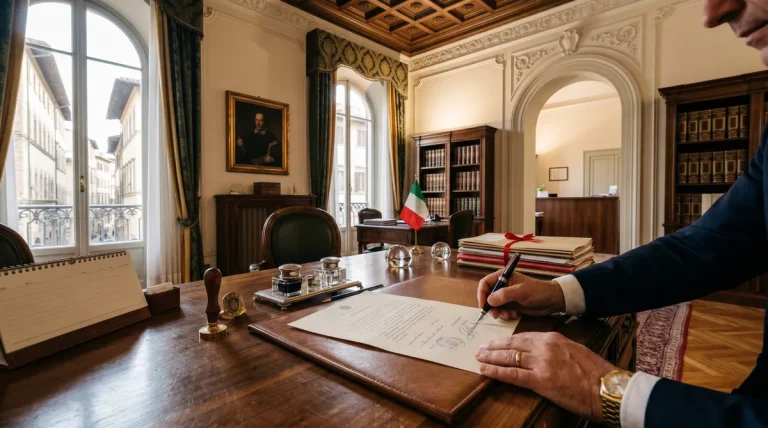
All property purchases in Italy must go through a notary (notaio), who is a state-appointed official responsible for the legal transfer. Notary fees are not fixed by law: each notary sets his or her own fee, so quotes for the same purchase can differ. Ask the notary you choose for a written estimate (preventivo) before you commit.
Your notary will also handle the registration of the purchase taxes on your behalf.
Agency Commission
In Italy both buyer and seller usually pay the estate agency commission. There is no statutory rate: it is agreed case by case and set out in writing before you commit to anything. At Salento Properties we put the figure in writing at the first meeting.
Purchase Costs: What the Taxes Come To
On the €250,000 example above, purchase taxes come to €8,200 for a second home, about 3.3% of the price, and €1,900 with the prima casa benefit, about 0.8%. The notary fee and agency commission come on top. This is for a purchase from a private seller: buying from a developer, where 10% VAT is charged on the price rather than on the cadastral value, costs considerably more — €25,600 in taxes on the same example, just over 10% of the price: the VAT plus €200 each in registration, mortgage and cadastral tax. Work from your own numbers rather than this example: the tax side turns on the cadastral value, which differs property by property and is often far below the price.
Special Tax Incentives to Know About
Flat Tax for New Residents (Regime dei Neo-Residenti)
This one is aimed at large foreign incomes, and it is a separate scheme from the retiree regime below. You pay a fixed sum each year in place of Italian tax on everything you earn abroad, whatever the amount: €300,000 for anyone transferring their tax residence from 1 January 2026, plus €50,000 for each family member brought into the regime. It was €100,000 when the scheme opened and €200,000 from 2024, so older articles quote a much lower figure. To qualify you must not have been an Italian tax resident for at least 9 of the previous 10 years.
7% Flat Tax for Retirees in Southern Italy
Different scheme, different rules, and no fixed sum to pay: retirees drawing a pension from abroad are taxed at 7% on their foreign income. The comune has to sit in one of eight southern regions, Puglia among them, and hold no more than 30,000 residents — a ceiling raised from 20,000 on 7 April 2026, which brought a band of mid-sized towns into the scheme. It applies from the year you move and for the nine that follow. Most of Salento is under the ceiling; Lecce and Nardò are not. The detail is in our guide for foreign retirees.
Frequently Asked Questions
Do I pay double taxation — both in Italy and in my home country?
Italy has double taxation treaties with most countries including the UK, Germany, the Netherlands, the USA and Australia. In most cases, you will not pay tax twice on the same income. We recommend consulting a cross-border tax adviser before completing your purchase.
Can I reclaim VAT if I buy a new-build for rental purposes?
If you purchase through a company (rather than as a private individual) and use the property for rental income, VAT reclaim may be possible. This requires specific legal and fiscal structuring — speak to an Italian commercialista (accountant) to assess your situation.
What happens if I sell a property in Italy within 5 years?
In Italy, if you sell a property within 5 years of purchase, the gain (plusvalenza) is taxed either at a 26% flat rate, chosen at the deed, or at ordinary income-tax rates. Two exclusions apply: property received through inheritance, and a home used as the main residence of the seller or their family for most of the period of ownership. After 5 years the gain is not taxed for private individuals.
Is there inheritance tax in Italy?
Italian inheritance tax rates are relatively low by European standards: 4% for direct heirs (spouse and children) with a €1 million exemption per heir. More distant relatives pay higher rates. Cross-border inheritance can be complex — always seek legal advice.
Our Advice
Understanding Italian property taxes is essential before you commit to a purchase, but the numbers are far more manageable than most buyers initially fear. With the right structure — and particularly with the prima casa benefit or the southern Italy retiree tax scheme — buying in Salento can be extremely tax-efficient.
The agency behind Salento Properties has worked in Salento since 1994, and this site is its English-language platform for foreign buyers. We work alongside trusted notaries, lawyers and commercialisti who specialise in international purchases. We make sure you understand every cost before you sign anything.
If you have questions about your specific situation, book a free consultation with our team. We are based in Lecce and Porto Cesareo, we speak English, and there is no obligation.
Ready to Take the Next Step?
Understanding the tax framework is the first step. The next is finding the right property in the right location — and that is where we can really help.
Get in touch with Salento Properties →
Free: The Salento Buyer's Checklist & Cost Breakdown
Know exactly what buying property in Salento costs — before you make an offer. Get the free 2026 checklist and total-cost breakdown by email.