Masseria for Sale in Salento: Buyer’s Guide to Puglia’s Farmhouses 2026
Few properties capture the imagination of international buyers quite like the masseria — Puglia’s historic farmhouse complex, built over centuries to manage the vast agricultural estates of the Salento countryside. Today, some of Italy’s most luxurious boutique hotels and private estates are former masserias; others await buyers willing to undertake a substantial restoration project that could yield an extraordinary home or income-generating property.
This guide answers the questions we are asked most often by British, German, Dutch and American buyers considering a masseria purchase in Salento.
What Is a Masseria?
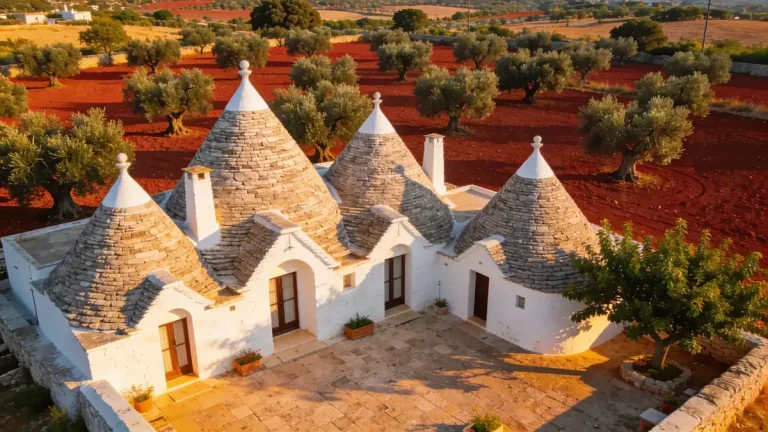
A masseria (plural: masserie) is a fortified farmhouse complex, typically dating from the 16th to 19th century, that served as the centre of a large agricultural estate. They were built to be self-sufficient — housing the landowner’s family, farm workers, animals, tools and produce — and many include:
- A main residence (the padrone’s quarters) — often imposing, with thick stone walls and vaulted ceilings
- Agricultural outbuildings, storage and animal quarters (stalle)
- A chapel (cappella) — common in larger estates
- Underground olive oil presses (frantoi ipogei) and cisterns
- Defensive towers in older examples
- Extensive land — often with centuries-old olive groves
The result is a compound rather than a single building — which is both the masseria’s greatest appeal (space, authenticity, multiple structures) and its most significant challenge (restoration costs, maintenance, planning complexity).
Where to Find Masserias in Salento
Masserias are concentrated in the agricultural interior of Salento — the flat, fertile plains between Lecce, Brindisi and Taranto that are carpeted with ancient olive groves. Key areas include:
- The area around Ostuni — very popular with international buyers; higher prices but proximity to the Adriatic coast
- Fasano and Cisternino surroundings — the Valle d’Itria transition zone
- Between Lecce and Otranto — Salento’s heartland, excellent value
- Around Nardò and Galatone — beautiful countryside, lower prices, access to both coasts
- The Brindisi hinterland — most affordable, most rural, genuine working-farm atmosphere
How Much Does a Masseria Cost in Salento?
Prices vary enormously based on size, condition, location and land included:
| Type | Price range |
|---|---|
| Small masseria (300–600 sqm), restoration needed | €150,000–€400,000 |
| Medium masseria (600–1,200 sqm), to restore | €300,000–€800,000 |
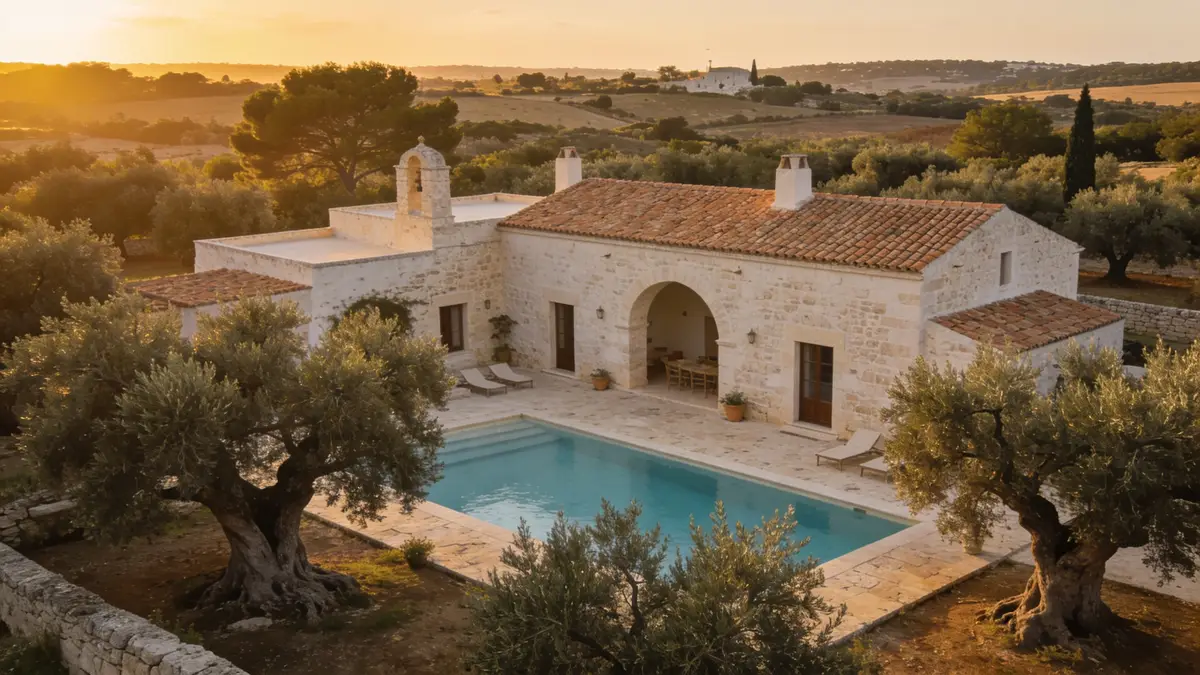
| Restored masseria, private home (3–6 beds) | €400,000–€1,200,000 |
| Restored masseria with pool, tourism licence | €600,000–€3,000,000+ |
| Large estate with multiple structures, land | €1,000,000–€10,000,000+ |
Note that the land (typically planted with olive trees) has its own value — centuries-old olive groves can be worth €5,000–€30,000 per hectare depending on tree age, condition and productivity. A masseria on 5 hectares of ancient olive grove has a very different underlying value to one on the same footprint of scrubland.
Restoration Costs: What to Expect
This is where many buyers are underprepared. A masseria that appears affordable at €200,000 may require €300,000–€700,000 in restoration to bring it to a high liveable standard.
Cost ranges (2026):
- Basic structural restoration (waterproofing, roof, structural elements): €400–€700 per sqm
- Full renovation to good residential standard: €800–€1,400 per sqm
- High-spec finish with pool, landscaping, wellness facilities: €1,500–€3,000 per sqm
For a 500 sqm masseria restored to a high standard, the construction cost alone could be €500,000–€800,000. Add the purchase price, professional fees, taxes and furnishing, and the total investment can easily reach €1,000,000+.
This is not a negative — a well-restored masseria of this scale in Salento is worth considerably more. But buyers need to enter the process with realistic expectations about total cost, not just purchase price.
Planning Permission and Heritage Constraints
Masserias are agricultural buildings and are subject to specific planning regulations in Puglia:
- Many are listed as beni architettonici (architectural heritage) — alterations require approval from the Soprintendenza (heritage authority)
- Changes to external appearance, roof lines and facades are typically strictly controlled
- Converting from agricultural to residential or tourism use requires a formal change-of-use application
- New construction (pools, annexes, additional buildings) requires planning permission and is constrained by agricultural zone rules
- Some properties have planning irregularities from past owners — these must be identified and regularised before purchase
A geometra (surveyor/architect) experienced in Puglian rural property planning is absolutely essential. Do not purchase without one.
Masseria as a Tourism Business
The most successful exit strategy for many masseria purchases is conversion to an agriturismo or boutique hotel. Puglia is one of Italy’s fastest-growing tourism destinations and demand for authentic rural accommodation far exceeds supply.
A well-positioned and well-run masseria agriturismo with 8–12 rooms and a pool can achieve:
- Peak season (June–September): €200–€500 per room per night
- Annual occupancy: 50–70% with effective marketing
- Annual revenue: €300,000–€800,000+ depending on size and positioning
Operating a hospitality business in Italy requires specific licences, knowledge of local regulations and Italian language skills (or reliable local management). Many international buyers hire experienced local managers or partner with established hospitality operators.
Masseria as a Private Holiday Home
Not all masseria buyers are looking for a business. Many simply want an extraordinary private retreat in one of Europe’s most beautiful and unspoilt rural landscapes. A restored masseria with a pool, surrounded by ancient olive groves with views across the Salento plain, is genuinely incomparable.
Even as a pure holiday home, a masseria can generate rental income when you are not using it — which many owners use to offset running costs. This does not require a full agriturismo licence if rooms are rented on a short-term basis under Italian holiday let rules.
Key Risks to Understand
- Planning irregularities — widespread in rural Italian property; must be fully investigated
- Title complexity — rural properties sometimes have complicated ownership histories with multiple heirs
- Restoration costs exceeding estimates — always add a 20–30% contingency to any restoration budget
- Timeline — restoration projects routinely take 50–100% longer than planned in Italy
- Isolation — some buyers find rural masseria life more isolated than they anticipated, especially in winter
- Maintenance — large stone properties with extensive olive groves require ongoing and significant maintenance investment
Frequently Asked Questions
Can I buy a masseria and convert it to a house?
Yes, subject to obtaining the correct planning permissions for change of use. The process involves the municipal planning office and potentially the regional heritage authority. A geometra familiar with local planning rules is essential.
Can foreigners buy agricultural land in Italy?
Yes. There are no restrictions on foreign nationals purchasing agricultural land in Italy, including the olive groves that typically accompany masserias.
How do I find off-market masserias for sale?
The best masserias rarely appear on public property portals. They are sold through personal relationships, local agents and word of mouth. This is one area where working with an established local agent adds real value — access to properties that never reach the open market.
Is the olive grove productive?
Many Salento olive groves are still productive and can generate modest agricultural income from oil production. However, maintenance costs (pruning, harvest, milling) must be factored in. Some buyers manage the grove themselves; others rent it to local farmers for a small annual fee.
How We Can Help
We have been matching international buyers with masserias and rural properties in Salento for decades. Our knowledge of the local market — including properties that are never publicly advertised — combined with our network of trusted geometri, lawyers and restoration specialists, means we can guide you through every stage of the process.
We will give you an honest picture of what a masseria purchase involves: the possibilities, the costs, and the risks. Our job is to help you make the right decision, not just close a sale.
Contact us to discuss masserias currently available in Salento →